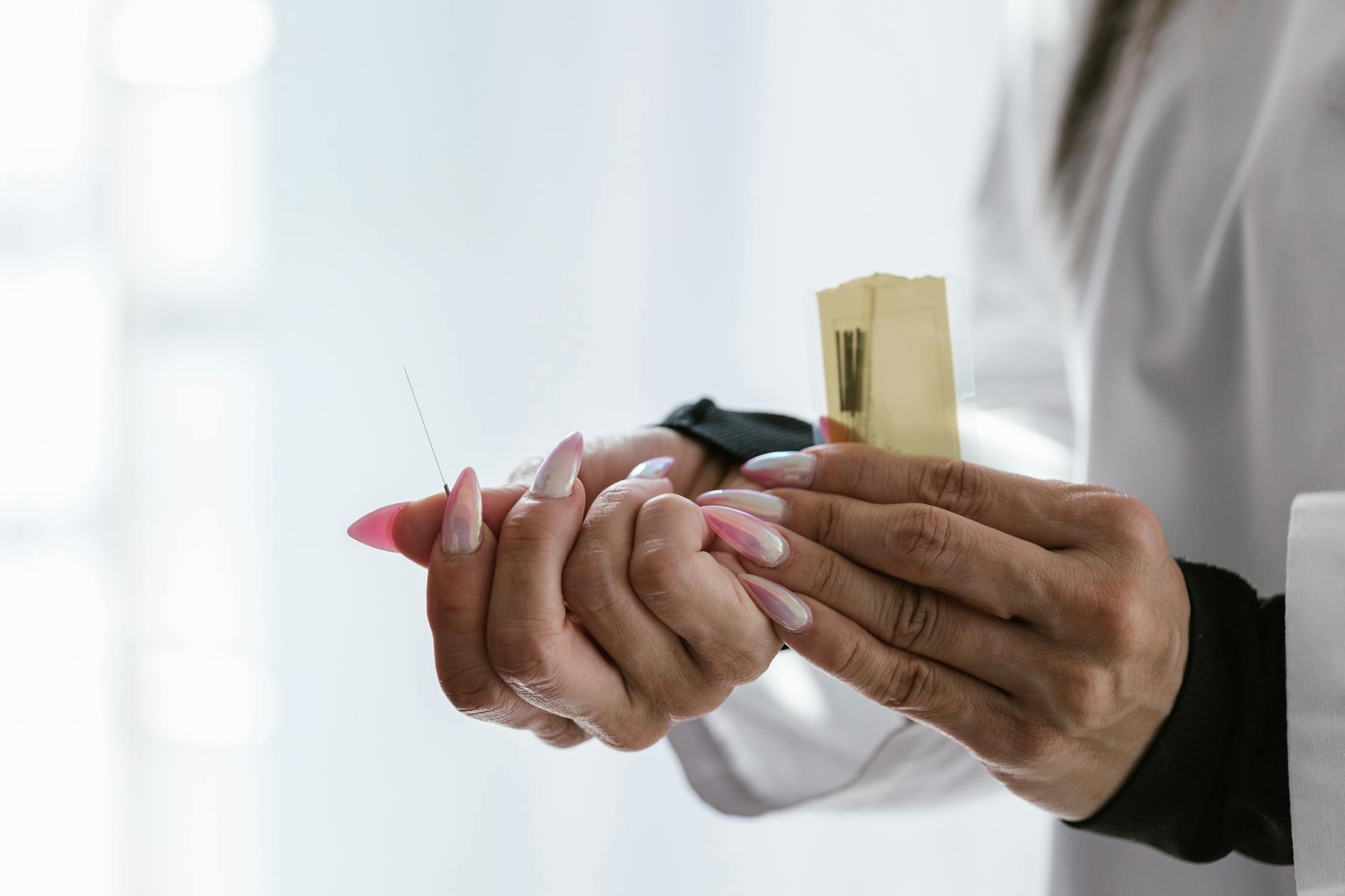
Dry needling is a therapeutic technique that involves inserting very fine needles into specific points within the muscle to release deep tension. Nothing is injected, the needle itself does the work, hence the word "dry".
Dry needling vs. acupuncture
The two are often confused, but they rest on fundamentally different foundations:
- Dry needling, grounded in anatomy and neurophysiology, targets trigger points inside muscles
- Acupuncture, rooted in traditional Chinese medicine, follows energetic meridians
The needles look alike, but the theory and the targeted points are distinct.
What is a trigger point?
A trigger point is a localised zone of involuntary contraction within a muscle. It produces:
- Local pain under pressure
- Referred pain (in an area away from the point)
- Stiffness and muscle weakness
The trapezius, gluteals, soleus, rhomboids and psoas are among the muscles most commonly affected.
How a session goes
- Palpation, I locate the trigger points by pressure
- Needle insertion, a thin needle is placed into the point
- Local twitch response (LTR), a brief involuntary muscle jump confirms the point has been released
- Removal, after a few seconds to a few minutes
What you'll feel
Most patients describe a sensation of pressure, heaviness or a light cramp during the twitch. It's not pleasant, but it's brief and signals relief on the way.
Who is it for?
- Chronic muscle pain
- Tendinopathies and insertional pain
- Neck and lower back pain
- Tension headaches
- Myofascial pain syndrome
- Sport recovery
Dry needling is often used alongside osteopathy to reach deep tension points that the hands alone can't fully release.